
Why Your Jaw Clenching Won’t Stop (Even With a Mouthguard)
If you wake up with jaw pain, headaches, or worn teeth, the problem may not start in your jaw at all.

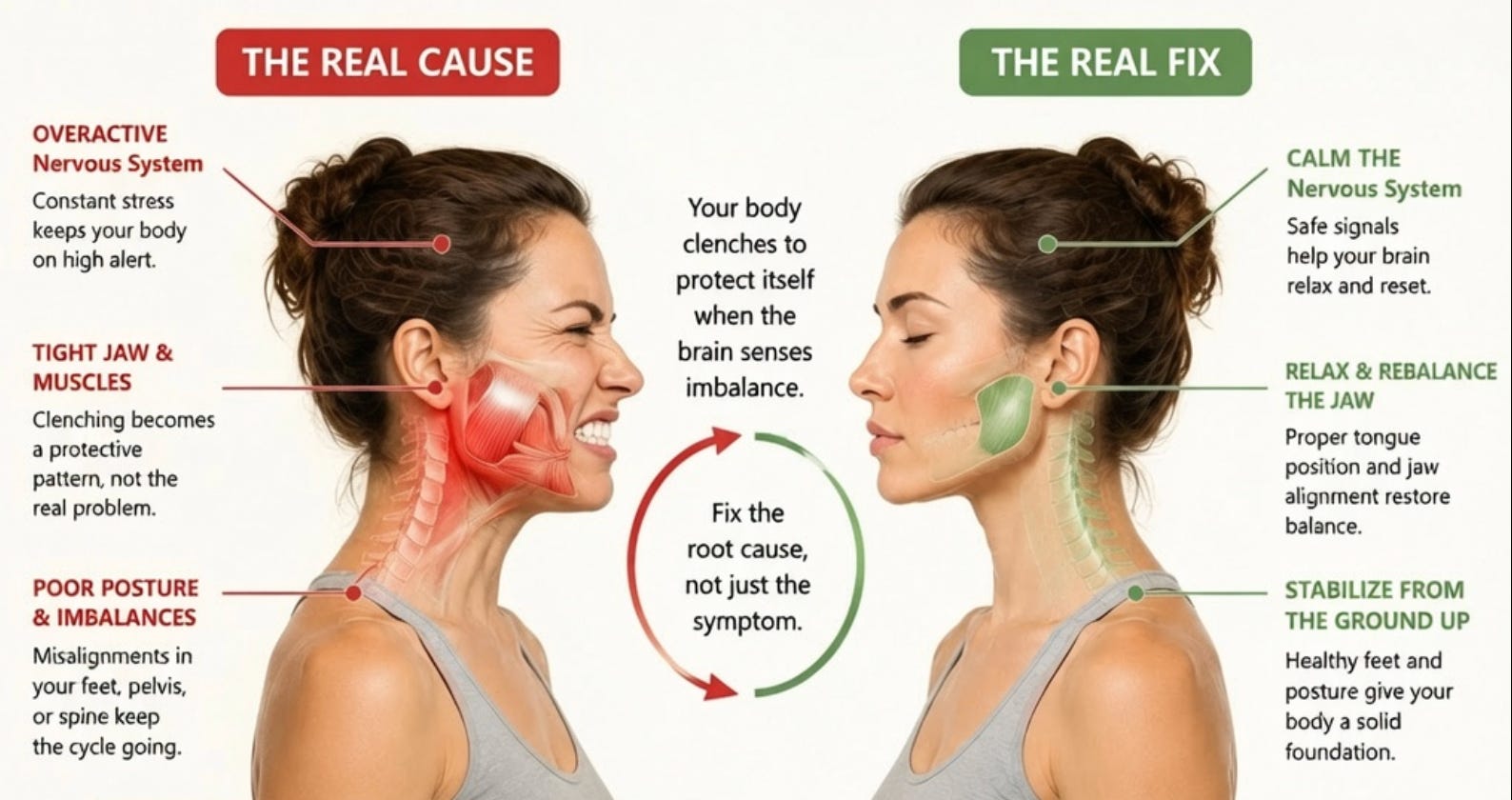
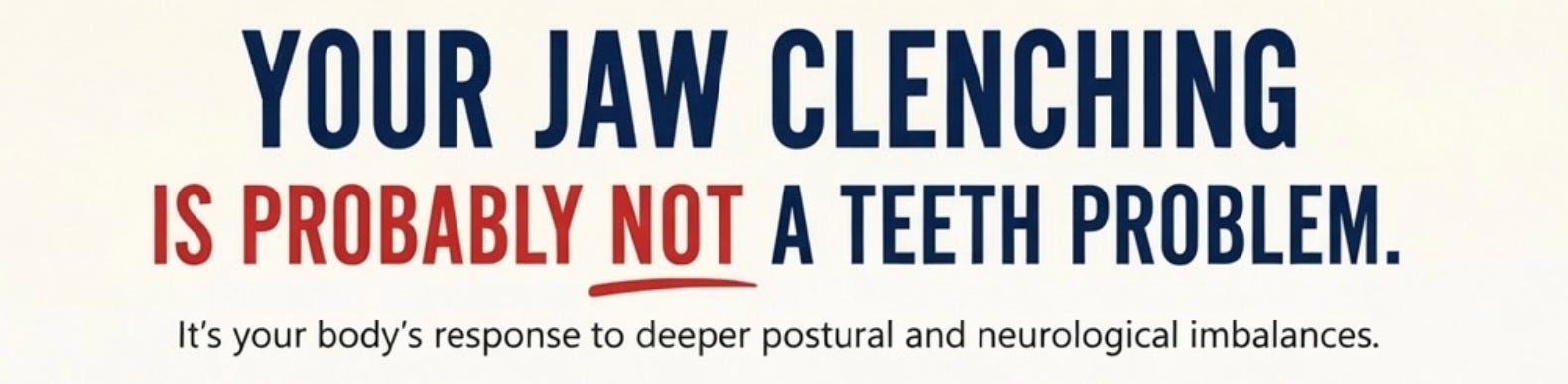
Most people think jaw clenching is a teeth problem. They wake up with sore jaw muscles, worn enamel, headaches, or tension through the face, and the first thing they assume is that their bite is wrong or they are just“bad at relaxing.”
So they get a mouthguard, they try to relax their jaw, and maybe they even see a dentist who focuses on the teeth and the joints. But the jaw is often where the force shows up, not where the pattern begins.
In 2024, a paper in Frontiers in Neurology described sleep bruxism as a complex behavior involving the central nervous system. That is not a small detail. It means that the grinding and clenching are not just about”bad teeth” or”stress” in the simple way people think.
The jaw is one part of a larger system that includes the brain, the autonomic nervous system, and the way the body handles arousal during sleep. When the nervous system is trying to manage instability at night, the jaw can become the place where that tension becomes visible.
That is why sleep research has repeatedly looked at the relationship between sleep bruxism and obstructive sleep apnea. The literature does not say that clenching always causes apnea or that apnea always causes clenching.
But it does show that these two patterns often appear together and that they may share common mechanisms around sleep arousals and breathing disturbances. When the airway becomes unstable at night, the jaw does not act like an isolated hinge. It responds as part of the same system that is trying to keep you breathing.
So the real question is not just why the jaw is clenching. The better question is what the body is trying to stabilize at night. And one of the missing layers in that conversation is the tongue.
The tongue is not just tissue sitting in the mouth. European sleep surgery consensus statements from 2025 place the tongue base, hypopharynx, and supraglottis at the center of snoring and obstructive sleep apnea evaluation.
The tongue’s position can change the space behind it, the way the jaw rests, and the signals the brain receives from the mouth and airway while you sleep. When the tongue rests against the upper palate, it gives the nervous system steadier input from the mouth, jaw, palate, and airway. When the tongue rests low, that input changes. The jaw can drop. The airway can become less stable. The brain receives a different map of what is happening while the body is supposed to be recovering.
That does not mean every clenched jaw is caused by the tongue. It does mean the jaw should not be looked at alone. If the tongue and airway are part of the same nighttime system, then jaw tension may be one visible output of a deeper pattern involving sleep instability, breathing disturbances, and the way the mouth is organized during sleep.
A mouthguard can protect your teeth from the force. That is valuable. But it does not change the resting pattern of the tongue, jaw, or airway. It does not change the input the brain is reading while you sleep. The guard addresses the damage, not the pattern behind the damage.
The Functional Activator is not a hard mouthguard. It is a trainer for the tongue and jaw. During use, it helps place the tongue toward the upper palate and supports a better resting relationship between the tongue, jaw, and airway. The value is repetition. Not a reminder. Not willpower. Repetition the nervous system can register over time.
This is the missing layer in the jaw clenching conversation. The research points to the brain. The sleep literature points to breathing and arousals. The airway research keeps returning to the tongue. And the jaw may simply be the place where the whole pattern becomes impossible to ignore.
If you clench at night, wake up with jaw pain, headaches, or signs of poor sleep, stop thinking only about the teeth. Start asking what your body is trying to stabilize at night. Your jaw might be clenching because your airway is closing.
Reference:
Manfredini D, et al. The neural substrates of bruxism: current knowledge and clinical implications. Frontiers in Neurology. 2024.
Consensus Statements Among European Sleep Surgery Experts on Tongue, Hypopharynx, and Supraglottis Associated with Snoring and Obstructive Sleep Apnea. Journal of Clinical Medicine. 2025.