
Stretching Doesn't Fix Posture (Your Nervous System Does)
Your body isn't tight. It's neurologically locked. Here's why that changes everything.

You’ve stretched your hip flexors. You’ve foam rolled your upper back. You’ve done the doorway pec stretch so many times you could do it in your sleep.
And your posture looks exactly the same as it did six months ago.
This isn’t a discipline problem. It’s not that you’re stretching wrong or not stretching enough. The issue is more fundamental than that — and once you see it, you can’t unsee it.
Stretching treats the symptom. It doesn’t touch the cause.
Your muscles aren’t the problem
Here’s what most people understand about posture: certain muscles are tight (hip flexors, pecs, upper traps) and certain muscles are weak (glutes, deep neck flexors, lower traps). The solution seems obvious — stretch the tight ones, strengthen the weak ones.
This model has been the foundation of posture correction for decades. And for decades, people have followed it faithfully without lasting results.
The reason is that muscle tightness is a downstream effect, not a root cause.
Your nervous system controls muscle tone. Every muscle in your body has a baseline level of tension that’s set by the brain — not by the muscle itself. When your brain perceives a need to protect or stabilize a particular area, it increases the resting tone in the surrounding muscles. That’s what you experience as “tightness.”
Stretching temporarily overrides this signal. The muscle elongates. You feel relief. But the nervous system hasn’t changed its instruction. Within hours — sometimes minutes the tone returns to exactly where it was.
This is why people stretch the same muscles for years without permanent change. The input signal that’s driving the tension was never addressed.
What’s Breaking Down Your Posture?
The three inputs that control your posture
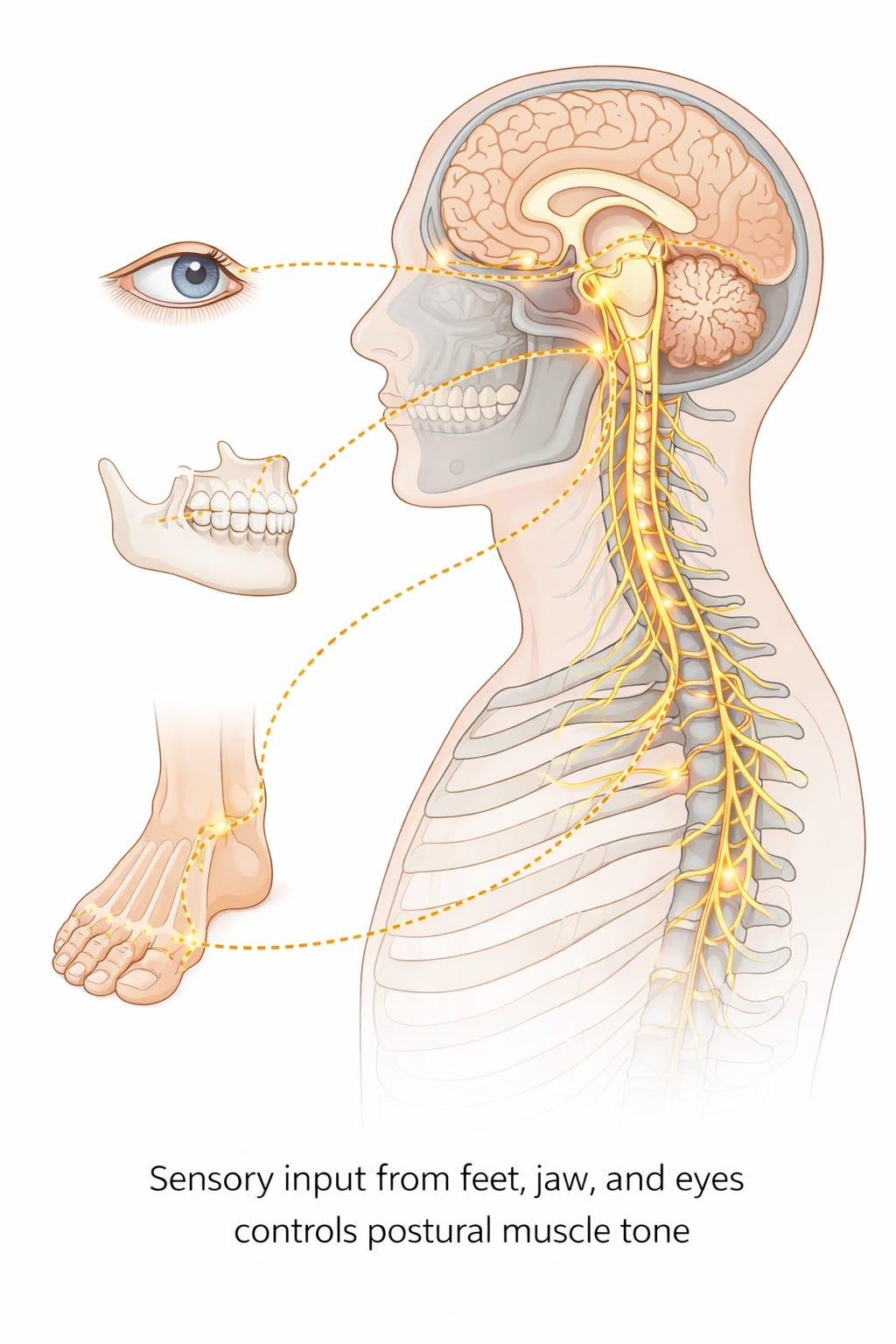
Your brain determines postural position based on three primary sensory inputs: what your feet feel, where your eyes track, and how your jaw aligns.
These three systems — proprioceptive, oculomotor, and stomatognathic — feed continuous data to the brainstem. The brainstem uses this data to set the resting tone of every postural muscle in the body.
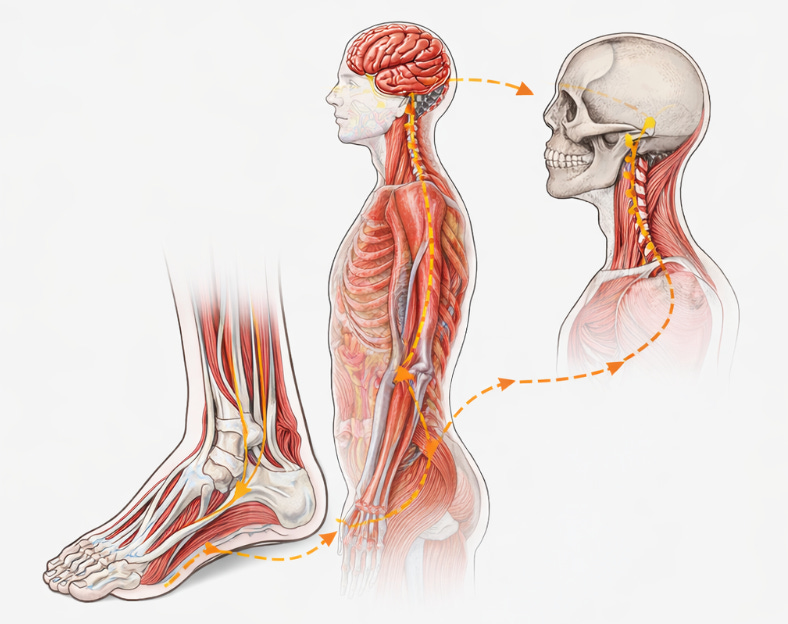
Your feet contain the highest density of mechanoreceptors of any surface on your body. These sensors tell the brain where you are in space, how weight is distributed, and whether the ground is stable. When foot mechanics distort — from collapsed arches, rigid shoes, or altered gait — the signal changes. The brain compensates by locking muscles further up the chain. Hip tightness, low back tension, and even shoulder rounding can originate from a distorted foot signal.
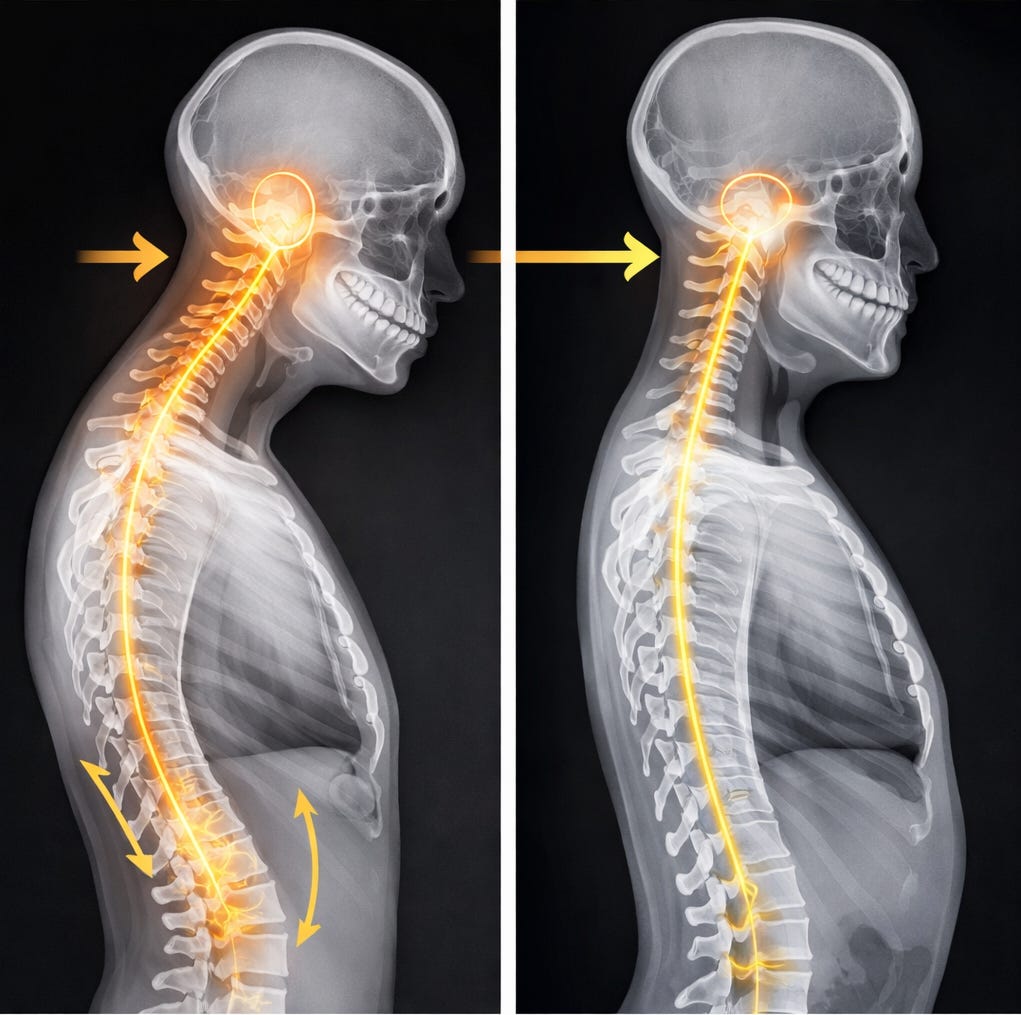
Your eyes control the suboccipital muscles at the base of the skull through the vestibulo-ocular reflex. These small muscles are responsible for fine head positioning. When eye tracking becomes dysfunctional — which happens with excessive screen use, convergence insufficiency, or vestibular disruption — the suboccipitals spasm. The head drifts forward. The upper traps and levator scapulae engage to support the new head position. Stretching the neck doesn’t change the eye pattern driving it.
Your jaw is connected to the pelvis through the deep front fascial line. Tension in the temporomandibular joint creates a compensatory cascade that travels through the anterior neck, the diaphragm, the psoas, and into the hip flexors. This is why people with TMJ dysfunction often have chronic hip tightness that doesn’t respond to stretching. The tension isn’t muscular in origin. It’s fascial, and it’s being driven from above.
What this means for correction
When the input signals change, the brain updates its postural program. Muscle tone redistributes. Joints decompress. Alignment shifts — not because muscles were stretched or strengthened, but because the nervous system received a different instruction.
This is the distinction between treating symptoms and addressing the pattern itself.
A tight psoas connected to a jaw compensation won’t release permanently from stretching. A rounded upper back driven by an eye tracking dysfunction won’t straighten from rows and band pull-aparts. A pelvis rotating from a collapsed foot arch won’t stabilize from core exercises alone.
Each of these requires identifying which input — feet, eyes, or jaw — is driving the compensation and correcting the signal at the source.
The order matters
One of the things that isn’t intuitive about this approach is that the sequence of corrections matters as much as the corrections themselves. Addressing the jaw before the feet can create a different compensation. Working on the eyes before establishing foot stability can destabilize the system temporarily.
The nervous system responds to input changes in a specific hierarchy. Foot proprioception sits at the base. Jaw and eye inputs layer on top. When the sequence follows this hierarchy, each correction reinforces the previous one. When it doesn’t, the brain has to choose between competing signals — and it defaults to the strongest compensatory pattern.
This is why isolated interventions — a mouth guard for TMJ, orthotics for flat feet, vision therapy for convergence — often help partially but don’t resolve the full postural pattern. Each one addresses a single input without accounting for the others.
The shift
Understanding that posture is neurologically driven — not muscularly — changes the entire approach.
It means that the body you’re currently living in isn’t “broken” or “weak.” It’s doing exactly what the nervous system is telling it to do based on the sensory input it’s receiving. The pattern makes sense when you see the inputs.
And it means that changing the inputs changes the pattern. Not temporarily. Not for the duration of a stretch. Structurally.
I spent over a decade developing the specific activation sequences that target these three input systems — feet, eyes, jaw — in the correct neurological order. The protocol is called the Posturepro Method and it’s the foundation of everything I teach.
If you’ve been stretching without lasting results, this is the piece that’s been missing.
For the full system correction including the foot and jaw protocol the Fix My Posture Bundle includes everything in one package.
Related reads to complete your posture correction: