
Why Your Posture Collapsed After Your Wisdom Teeth Were Removed
The jaw-to-foot connection dentists never mentioned, and what it means for your entire body

Try This Right Now
Stand sideways in front of a mirror.
Look at your head. Is your ear forward of your shoulder?
Now place two fingers just in front of each ear. Open and close your mouth slowly.
Do you feel clicking? Grinding? Does one side move before the other?
Finally, look down at your feet. Are your arches collapsed? Do your ankles roll inward?
If you answered yes to any of these the problem may have started years ago in a dental chair.
In This Article, You Will Discover
Why removing wisdom teeth eliminates the back wall of your jaw and compresses the joint into your skull
How this compression forces your head forward to keep your airway open
The downstream effect on your feet as your brain scrambles to stabilize a shifted center of gravity
Why two thirds of wisdom teeth extractions are medically unnecessary according to published research
The meridian connection between wisdom teeth and your heart and small intestine that holistic practitioners have recognized for centuries
Why dental work done without considering foot and eye balance often fails
The bottom-up and top-down approach that addresses both ends of the compensation chain
Ten Million Extractions Per Year
Approximately 10 million wisdom teeth are extracted from 5 million people in the United States every year.
The standard reasoning: prevention. The teeth might become impacted. They might crowd other teeth. They are difficult to clean.
But a 2007 study published in the American Journal of Public Health found that two thirds of these extractions are unnecessary. The author, Dr. Jay Friedman, called prophylactic wisdom teeth removal “a public health hazard” that results in over 11 million patient days of pain, swelling, and disability annually.
The British National Health Service reached a similar conclusion. Their National Institute for Clinical Excellence stated: “The practice of prophylactic removal of pathology-free impacted third molars should be discontinued. There is no reliable evidence to support a health benefit to patients from the prophylactic removal of pathology-free impacted teeth.”
A Cochrane systematic review updated in 2020 confirmed: there is no evidence to support or refute routine prophylactic removal of asymptomatic impacted wisdom teeth.
So why do dentists keep removing them?
The Uncomfortable Truth
Wisdom teeth sit at the very back of your mouth. They are difficult to reach with a toothbrush. They are even more difficult to reach with dental instruments during a cleaning.
For a dentist, leaving wisdom teeth in place means more time spent maneuvering in tight spaces at every appointment. More risk of decay in areas that are hard to monitor. More liability.
Removing them simplifies everything.
The standard protocol taught in most dental schools emphasizes prevention of potential future problems. But this protocol was developed without any consideration for what wisdom teeth actually do mechanically.
Wisdom teeth are not vestigial. They serve a critical structural purpose.
What Wisdom Teeth Actually Do
Your wisdom teeth act as the back wall of your dental arch.
They help distribute the forces of chewing evenly across all your teeth. When you bite down, pressure travels through your molars into your jaw, then into your skull. This pressure needs to be balanced across the entire arch.
When you remove the wisdom teeth, the remaining teeth have to absorb extra load. The teeth closest to the gap start to tilt backward. The bite changes. The vertical height at the back of your jaw drops.
This is where the real problem begins.
The Joint Inside Your Skull
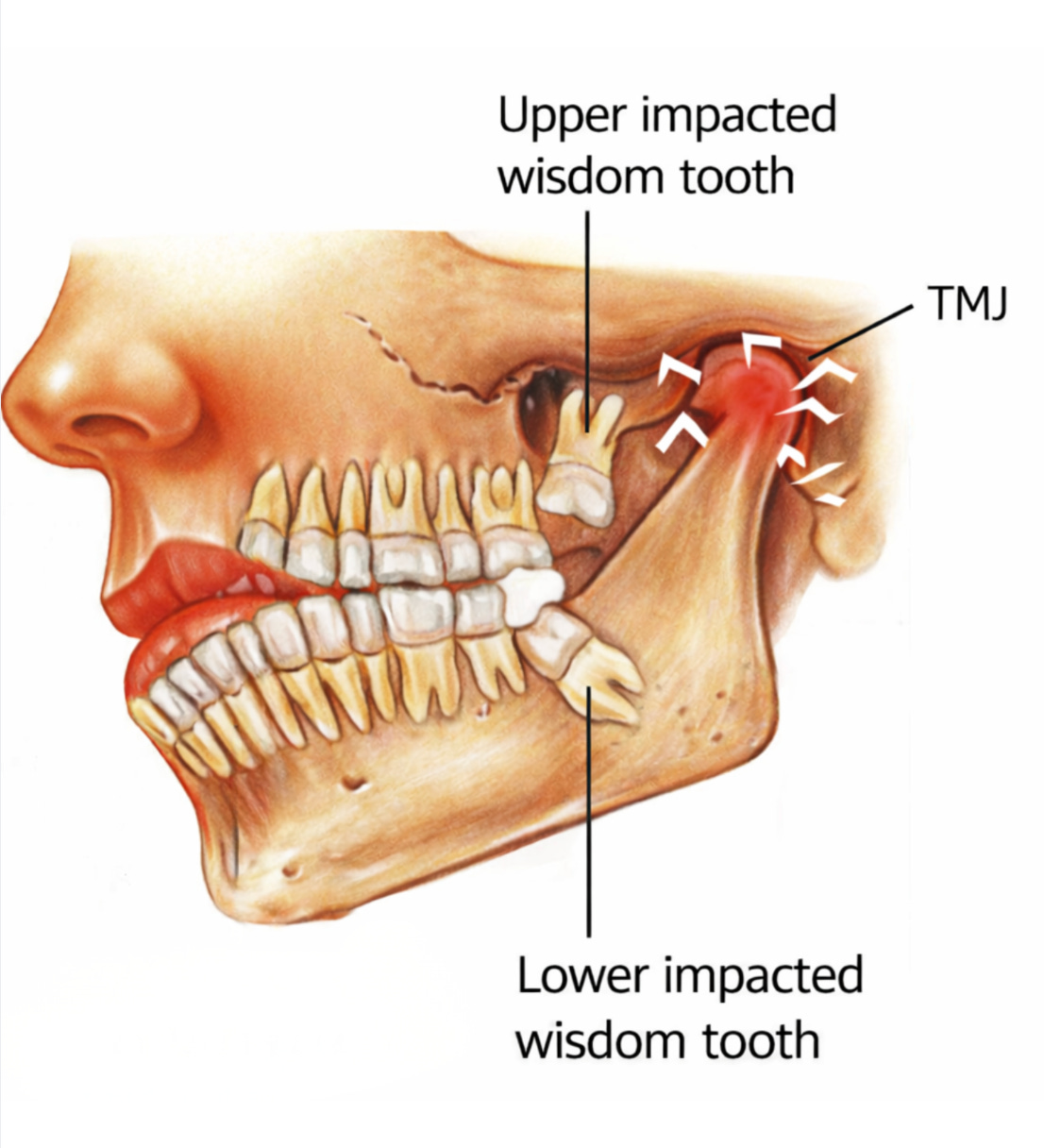
Your jaw connects to your skull through the temporomandibular joint. The round end of your lower jaw, called the condyle, sits inside a small depression in your skull called the fossa.
When all your teeth are present, including your wisdom teeth, this condyle sits in a specific position. The height of your back teeth determines how deep or shallow that condyle rests.
Remove the wisdom teeth, and the back of your jaw loses vertical support. The condyle compresses deeper into the fossa.
A 2024 study published in the Journal of Craniomandibular Practice found that tooth position is an independent risk factor for temporomandibular disorders, and that mandibular molar extraction, especially wisdom tooth extraction, is particularly likely to cause TMD.
This compression does three things:
First, it irritates the disc and tissues inside the joint. Clicking starts. Then grinding. Then pain.
Second, it changes the angle of your entire lower jaw relative to your skull.
Third, it forces your head to shift forward.
Why Your Head Moves Forward
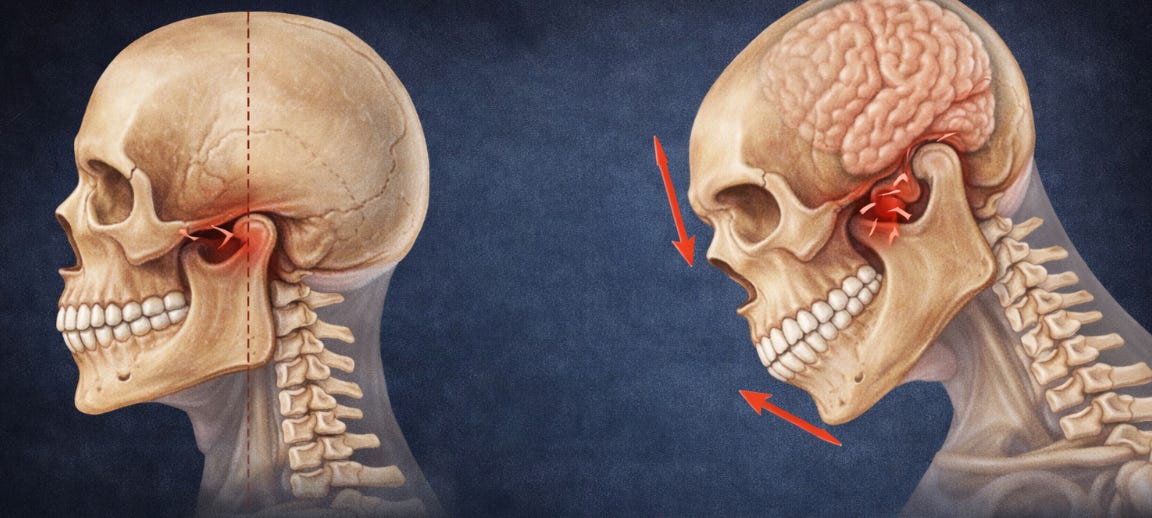
When the position of the jaw joint changes, it alters the alignment of the skull. To compensate for this tilt and maintain a clear airway, the neck muscles engage to pull the head forward.
The load distribution across the TMJ affects how the skull rests on the spine. If the posterior part of the joint loses pressure, the mandible shifts, the skull tilts, and the brain adapts posture to compensate.
A 2023 study of 384 patients published in Pain Research and Management found that TMD patients with TMJ pain showed significantly increased forward head posture compared to those without TMJ pain and those without TMD entirely. The more severe the TMD, the more pronounced the forward head posture.
This is a mechanical cause-and-effect response.
Your head weighs approximately 10 to 12 pounds. For every inch it shifts forward, the load on your cervical spine increases by an additional 10 pounds. At two inches forward, your neck muscles are working against 30 pounds of effective weight.
This is why your neck is always tight. This is why the base of your skull aches. This is why stretching never fixes it.
The tension is not the problem. The tension is the compensation.
The Cascade Continues Downward
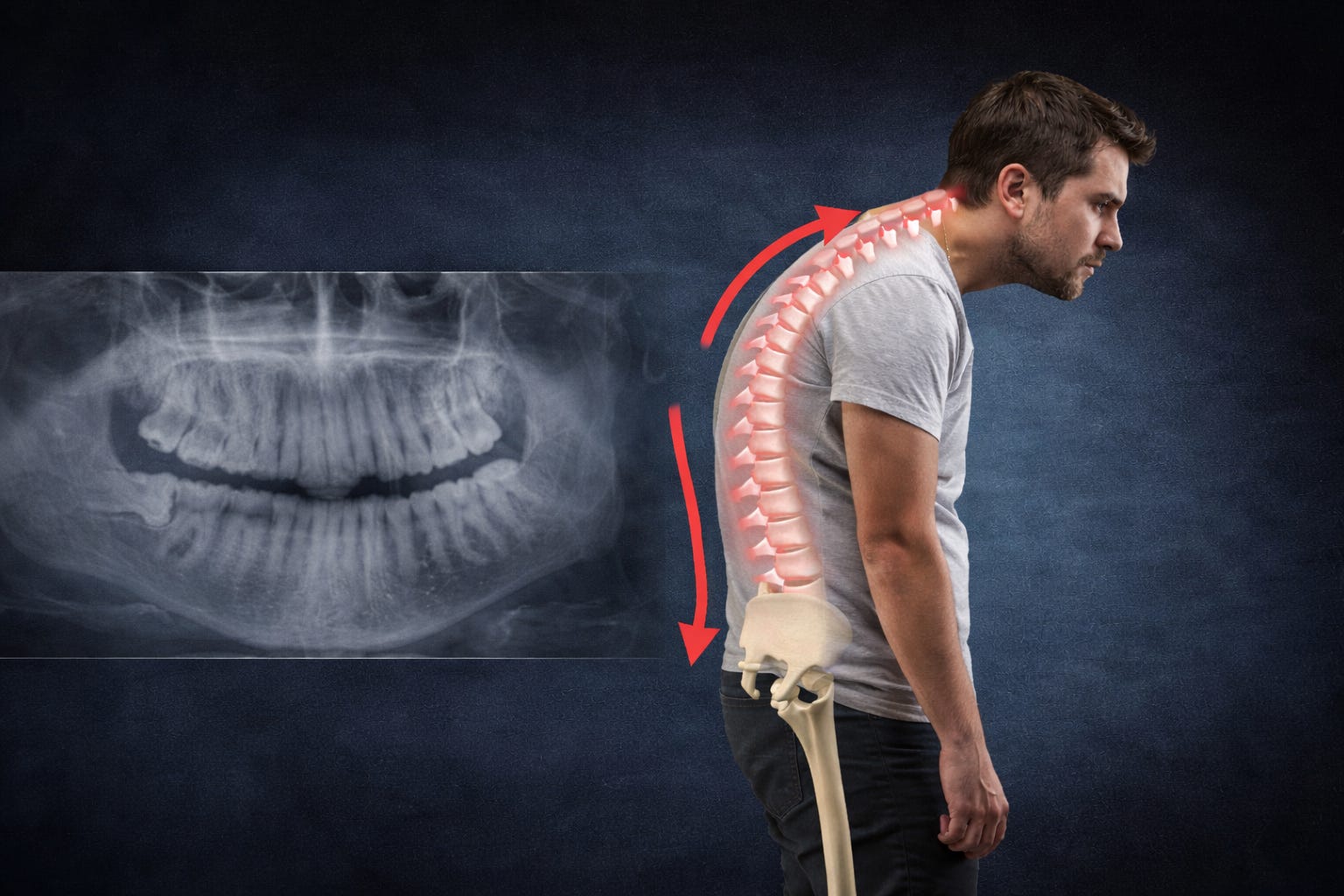
When your head shifts forward, your center of gravity moves anterior.
Your brain now has a new problem: how to keep you from falling forward.
The answer comes from your feet.
Your feet contain thousands of mechanoreceptors that send constant signals to your cerebellum about pressure distribution, ground contact, and joint position. This information is essential for balance and posture.
When your center of gravity shifts forward, your feet adapt. Often this means the arches collapse. The ankles roll inward. Bilateral pronation develops.
Now the sensory input from your feet becomes distorted. Your brain receives unreliable information about your body’s position relative to gravity. It compensates with inefficient movement patterns, increased muscle tension, and heightened energy expenditure just to stand upright.
The misalignment travels up the entire kinetic chain: ankles, knees, hips, spine. Each level compensates for the one below it.
This is how a jaw problem becomes a whole-body dysfunction.
The Sensitivity You Were Never Told About
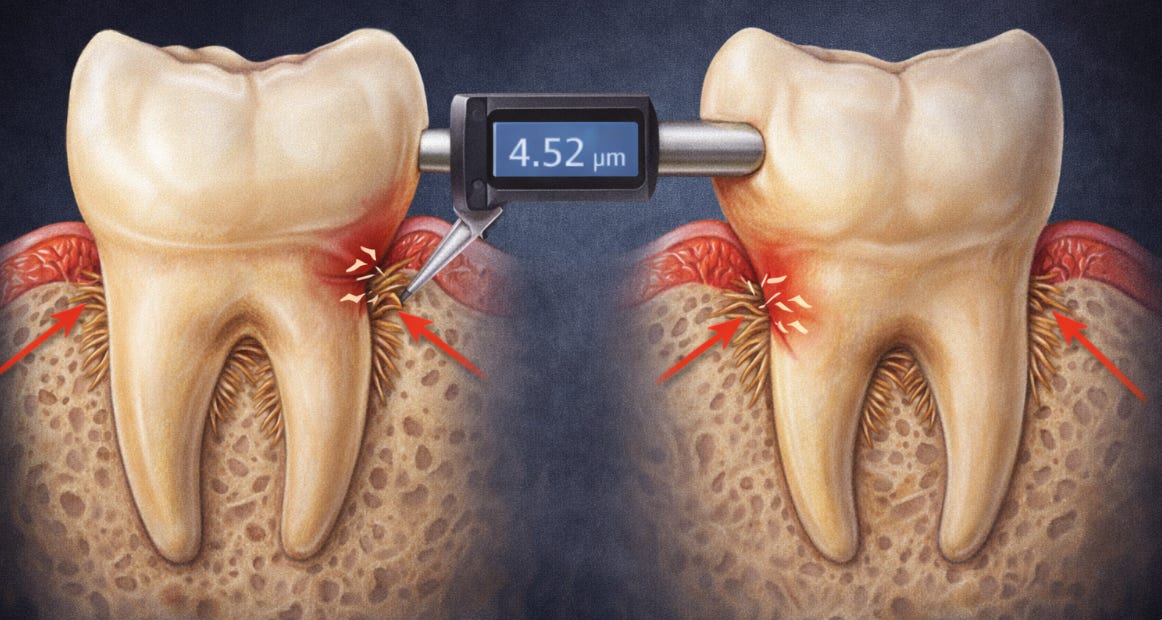
The ligaments around each tooth root, called desmodontal ligaments, are extraordinarily sensitive. They can detect pressure differences measured in microns.
These ligaments send continuous feedback to your brain about bite position. That feedback influences muscle tone throughout your entire body.
This is why dental work done without considering foot and eye balance often overcorrects or undercorrects. Change the bite by a fraction of a millimeter, and you change how someone stands.
Most dentists are not trained to think this way. They treat teeth as isolated structures.
But teeth are part of a sensory system that includes the feet, the eyes, and the jaw working together to tell your brain where you are in space.
The Meridian Connection (A Pattern Dentists Don’t Study)
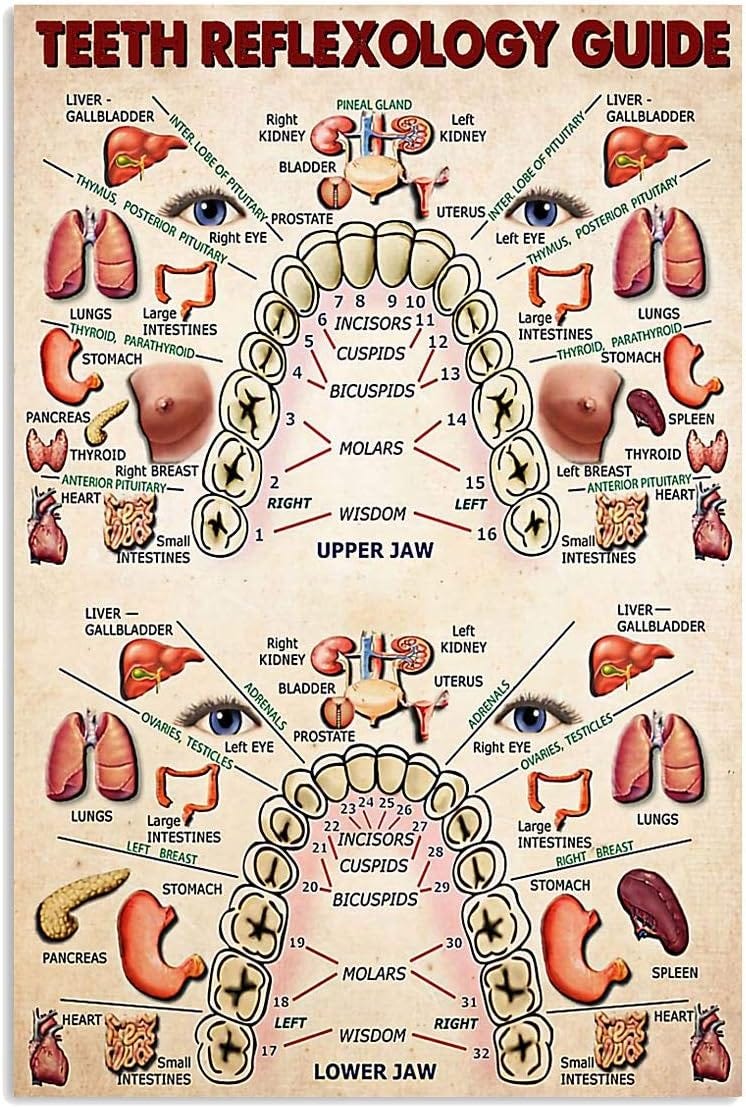
Before modern biomechanics, clinicians relied on long-term pattern observation.
Traditional Chinese medicine mapped recurring relationships between teeth, organs, and systemic symptoms through what it called meridians. These were not anatomical structures, but functional maps — a way of tracking consistent downstream effects when specific structures were altered.
Modern dentistry does not study these patterns. That does not mean the patterns do not exist.
Wisdom teeth sit on the heart and small intestine meridian maps used in TCM. The lower wisdom teeth correspond to the heart system. The upper wisdom teeth correspond to the small intestine system.
Biological dentists and integrative practitioners who track post-extraction symptoms consistently report clusters that align with these maps: anxiety, sleep disruption, circulation irregularities, and digestive sensitivity appearing after wisdom tooth removal.
Whether you interpret this through an energetic framework or view it simply as another way of describing systemic stress responses, the observation is consistent:
Removing wisdom teeth affects more than just the mouth.
What Happens If They Are Already Gone
If your wisdom teeth were removed years ago, you cannot put them back.
But you can address the compensation pattern they left behind.
The compensation has two ends:
Top down: The jaw position changed. The head shifted forward. The neck muscles locked into chronic tension.
Bottom up: The feet adapted to the shifted center of gravity. The arches collapsed. The sensory input to the cerebellum became distorted.
Addressing only one end does not resolve the loop. The brain needs accurate information from both directions to recalibrate.
What This Means For You Right Now
If you have had wisdom teeth removed and experience any of these symptoms, consider whether the extraction may be the hidden driver:
Jaw clicking, popping, or grinding
Chronic neck tension that never fully releases
Forward head posture that returns no matter how much you stretch
Headaches at the base of your skull
Shoulder tension worse on one side
Collapsed arches or feet that roll inward
Digestive sensitivity that appeared after dental work
Anxiety or sleep issues that started after extractions
These are not random complaints. They are signals that your system is compensating for a structural change that was never addressed.
This is why the Fix My Posture Bundle works when other approaches fail. It restores bottom-up sensory accuracy through Therapeutic Insoles that correct ground reaction forces and stabilize your center of gravity.
At the same time, it restores top-down regulation through the Functional Activator, a jaw and tongue positioning tool that retrains how your nervous system organizes head, neck, and airway position.
When both inputs are corrected simultaneously, the brain no longer needs to maintain compensations.
Why Most Solutions Fail (And Why This Matters Before You Try Anything Else)
At this point, it’s important to pause.
If you’ve tried posture exercises, chiropractic adjustments, physical therapy, massage, or stretching, and nothing held, it was because each intervention addressed only one side of the compensation loop.
Correcting muscles without correcting sensory input doesn’t last.
Correcting the spine without correcting ground reaction forces doesn’t hold.
Correcting the jaw without correcting how the brain stabilizes the body fails quietly over time.
The nervous system needs accurate information from both ends to reorganize posture.
Without that, it will always return to the safest compensation it knows.
Now the solution lands naturally, not defensively.
The Path Forward
You have two options.
Continue treating symptoms. Massage the neck. Adjust the spine. Stretch the tight muscles. Watch them return within days.
Or address the inputs.
Your posture is not a habit problem. It is a sensory problem. Your brain organizes your body around the information it receives from your feet, your eyes, and your jaw.
If one of those inputs was disrupted by an extraction years ago, your brain has been compensating ever since. The compensation became your posture. The posture became your pain.
What Actually Works When the Teeth Are Already Gone
If your wisdom teeth were removed years ago, you cannot put them back.
But you can correct the compensation pattern they left behind.
That compensation has two ends:
Top down:
The jaw position changed. The head shifted forward. The neck locked into chronic tension.
Bottom up:
The feet adapted to the shifted center of gravity. The arches collapsed. Sensory input to the cerebellum became distorted.
Addressing only one end does not resolve the loop.
This is why the Fix My Posture Bundle works when isolated approaches fail.
It restores bottom-up sensory accuracy through Therapeutic Insoles that correct ground reaction forces, while simultaneously addressing top-down regulation through jaw and tongue positioning tools.
When the brain receives corrected input from both directions at the same time, posture reorganizes without forcing, stretching, or constant conscious effort.
The Connection Nobody Else Is Making
Dentists treat teeth. Chiropractors treat spines. Physical therapists treat muscles.
Nobody is looking at how removing the back wall of your jaw changed the position of your skull and everything below it.
This is the connection Posturepro exists to make visible.
Your body is one integrated system. What happens in your mouth affects your feet. What happens in your feet affects your brain. The loop runs continuously.
Fix the inputs. The posture follows.
Related reads to complete your posture correction:
References
Friedman JW. The Prophylactic Extraction of Third Molars: A Public Health Hazard. American Journal of Public Health. 2007;97(9):1554-1559. https://pmc.ncbi.nlm.nih.gov/articles/PMC1963310/
Song F, O’Meara S, Wilson P, Golder S, Kleijnen J. The effectiveness and cost-effectiveness of prophylactic removal of wisdom teeth. Health Technology Assessment. 2000;4(15):1-55. https://pubmed.ncbi.nlm.nih.gov/10932022/
Ghaeminia H, et al. Surgical removal versus retention for the management of asymptomatic disease-free impacted wisdom teeth. Cochrane Database of Systematic Reviews. 2020. https://www.cochrane.org/CD003879/ORAL
Journal of Craniomandibular Practice. The clinical study and multi-factor analysis of temporomandibular joint disorder induced by tooth extraction. 2024. https://www.sciencedirect.com/science/article/abs/pii/S0011384024001151
Xiao CQ, et al. Do Temporomandibular Disorder Patients with Joint Pain Exhibit Forward Head Posture? A Cephalometric Study. Pain Research and Management. 2023. https://pubmed.ncbi.nlm.nih.gov/36776487/
Espí-López GV, et al. Correlation between Temporomandibular Disorders (TMD) and Posture Evaluated through the Diagnostic Criteria for Temporomandibular Disorders (DC/TMD): A Systematic Review with Meta-Analysis. Journal of Clinical Medicine. 2023. https://pmc.ncbi.nlm.nih.gov/articles/PMC10095000/
Rodríguez-Sanz D, et al. TMJ Dysfunctions Systemic Implications and Postural Assessments: A Review of Recent Literature. International Journal of Environmental Research and Public Health. 2020. https://ncbi.nlm.nih.gov/pmc/articles/PMC7739223